
They started with a cardholder who didn't recognize a charge they actually made. The merchant wrote the descriptor. The acquirer boarded it. But the call, the case, and the cost land on you.
Dispute-cause figures from Chargeback Gurus — Srii Srinivasan, co-founder and former CEO, interviewed July 2025. Per-dispute cost is what issuers tell us directly, fully loaded across handling, provisional credit, and write-off. Read together they describe the issuer's position precisely: the confusion starts upstream, the cardholder brings it to you, and you carry the cost of resolving it.
A descriptor nobody recognizes doesn't stay a merchant problem. It arrives at your bank as contact volume, casework, distorted risk signals, and a worse app experience.
“What is this charge?” is among the most common reasons a cardholder calls at all — a fully-loaded contact spent confirming a purchase the customer genuinely made.
Every unrecognized charge that becomes a claim opens a case, consumes an analyst, and moves through your dispute process at full cost before anyone establishes the transaction was legitimate.
Confusion-driven claims enter your systems labeled as fraud. That noise trains models, drives false declines, and buries the genuine fraud your team actually needs to find.
The cryptic string sits in your banking app under your brand. The merchant wrote it, but the cardholder experiences it as your bank failing to tell them where their money went.
The networks have decided cardholders should see a merchant they recognize — and they have written that obligation onto banks, not merchants. Mastercard's standard is already in force for issuers across the Europe region, requiring the merchant's DBA name, contact details, location, and logo to be shown on request in your app, wallet, or online banking. Visa's counterpart display requirement for issuers follows in January 2027.
“Friendly fraud is often the result of unrecognizable merchant identifiers in transaction details. Cardholders mistakenly initiate chargebacks because they do not recognize the purchase or merchant descriptor. Many chargebacks may be avoided by providing cardholders with a more detailed description of the transaction.”
Mastercard AN 4569 — Standards for the Display of Enhanced Merchant Data by Issuers
Most merchant-identity data reaches a bank by matching a noisy transaction string to the most probable business. The engineering behind that is genuinely good, and it resolves the majority of transactions — but every inference-based approach shares one dependency: it can only be as accurate as the source data underneath it. Where that source is missing, a probable answer is displayed under your brand, and the wrong merchant name is worse for a cardholder than no name at all.
Records come directly from the acquirers, ISOs, and merchants themselves — parties who know the merchant because they boarded it or operate it. Never scraped from the open web, never inferred by a model.
Every record carries its origin and the date it was last confirmed, and the file is refreshed on a monthly cycle. You always know how current the identity you're displaying actually is.
Contributors aren't a one-time data dump. Acquirers, ISOs, and merchants participate on an ongoing basis, correcting and enriching their own records as businesses change hands, rebrand, or move.
The genuinely hard part: confirming the real support phone, chat, email, and refund route for each merchant, one at a time. That work is done upstream so your agents and cardholders can act on it with confidence rather than verifying it themselves.
Telling a cardholder who charged them answers the question. It doesn't help the ones who recognize the merchant and still want something done. And today, in almost every banking app, there is exactly one thing they can do about a charge they're unhappy with: dispute it. That single button turns every complaint — however small, however resolvable — into a case on your desk.
Each of these is a resolved concern instead of a case — a materially cheaper outcome than a worked dispute, and a better experience for the cardholder, who gets their answer in minutes rather than waiting out an investigation.
Today: unrecognized charge → call your contact center → case opened → chargeback processed → cost absorbed.
With Descriptors.com: unrecognized charge → cardholder sees the verified merchant → resolves it directly → no contact, no case.
Nothing here sits between a cardholder and their right to file. Resolution paths are offered alongside the dispute route — never as a precondition, a gate, or a delay — so your error-resolution obligations and timelines under Regulation E are unchanged. What changes is how many cardholders need to reach for the dispute button at all.

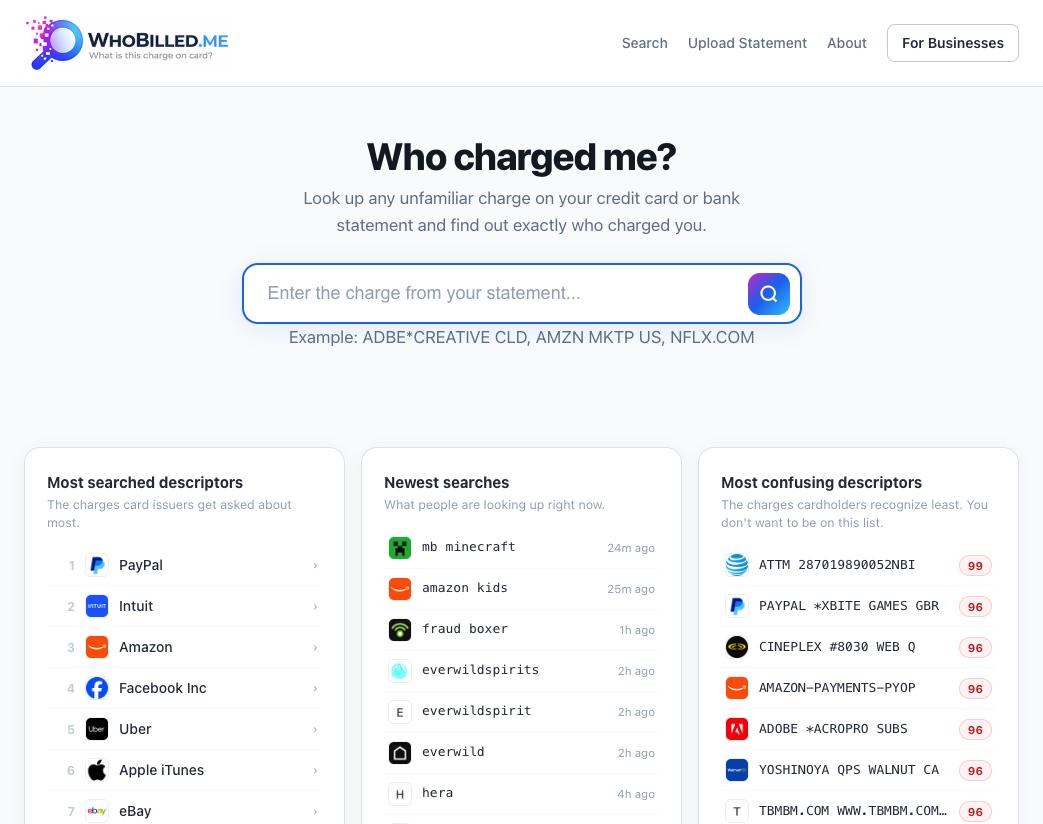
When a charge isn't recognized, the first move is usually a search, not a phone call. WhoBilled.me — the free consumer lookup service powered by Descriptors.com — answers that search with the verified merchant behind the charge, and a way to reach them. Every question answered there is a contact your center never receives.
This isn't a roadmap item waiting on an integration project. The descriptor data is live now, and there are two ways into it depending on how much engineering you want to spend.
Your dispute and contact-center agents can look up any descriptor in a browser from day one. No API, no development work, no release cycle. When a cardholder asks “what is this charge?”, the agent can actually answer — on the call, before a case is opened.
The same verified records are available through an API for the teams that want identity, contact details, and resolution pathways surfaced natively in the banking app, the agent desktop, or the dispute-intake workflow.
Your dispute volume, your cost per dispute, your call volume — and what deflecting even a small share is worth a year.
—
Browser lookup from day one — no integration, no release cycle. API when you're ready.
The ladder is coverage-first. Deflection is applied only to the share of your confusion volume that sits on descriptors the registry already covers — your top-flagged head, set above from your own dispute-volume ranking. Coverage widens as merchants claim descriptors, and the note under the ladder shows the full-coverage figure.
The head is not hypothetical. WhoBilled.me analyzed 192,911 real statement descriptors and built coverage for all 372 descriptors most frequently flagged in card-issuer dispute data — including the aggregator prefixes and processor strings no cardholder can decode. The most-looked-up merchants are household names, which is exactly why the head of your dispute ranking concentrates the way it does. Your dispute-volume ranking and our coverage list are substantially the same list.
Resolution rates in the ladder's range are documented for descriptor-detail programs — Visa reports Order Insight deflecting 40–45% of confirmed first-party-misuse disputes, up to 90% for some subscription merchants. The ladder still treats the rate as a scenario, not a promise.
The $85 default sits inside the commonly cited $75–100+ fully-loaded range for working a dispute. Replace it with your own figure.
Resolution paths sit alongside dispute rights, never in front of them. A descriptor lookup answers the recognition question; nothing about it gates, delays or discourages a cardholder's right to dispute under Reg E, Reg Z or network rules.
This is an arithmetic model of your own inputs, not a performance guarantee or a forecast. Actual results depend on descriptor coverage, your cardholder base and your dispute mix.
We're partnering with a select group of issuers to bring Descriptors.com to market. Early adopters don't just get early access — they get a permanent stake in where the product goes.
Lock in preferred early-partner rates that stay with you as the platform — and its price — grows.
Direct influence over the roadmap — your workflows, data needs, and priorities built into the final product.
A standing seat alongside peer institutions, with a voice in strategy well beyond your own deployment.
Seats are limited by design. Talk to us about joining the founding group of issuers behind Descriptors.com.
