

The descriptor is the merchant name a cardholder sees on their statement — and one of the most overlooked causes of disputes. Descriptors.com maps every cryptic charge to a verified merchant, so customers, banks, and issuers recognize it on sight. No API. No integration. No processor change.
The descriptor is a short string in a format built in the 1970s for printed statements — and it is still the only thing most cardholders ever see. Even the world's most recognizable brands surface as cryptic abbreviations: an unfamiliar acquirer code, a parent-company name, a truncated DBA. The cardholder doesn't recognize it. They call their bank. The bank files a dispute. No other option is ever offered.
A legal entity the customer has never heard of — they bought from a coffee shop — and a phone number with no context. The likely outcome: “I didn't make this charge” — a dispute.
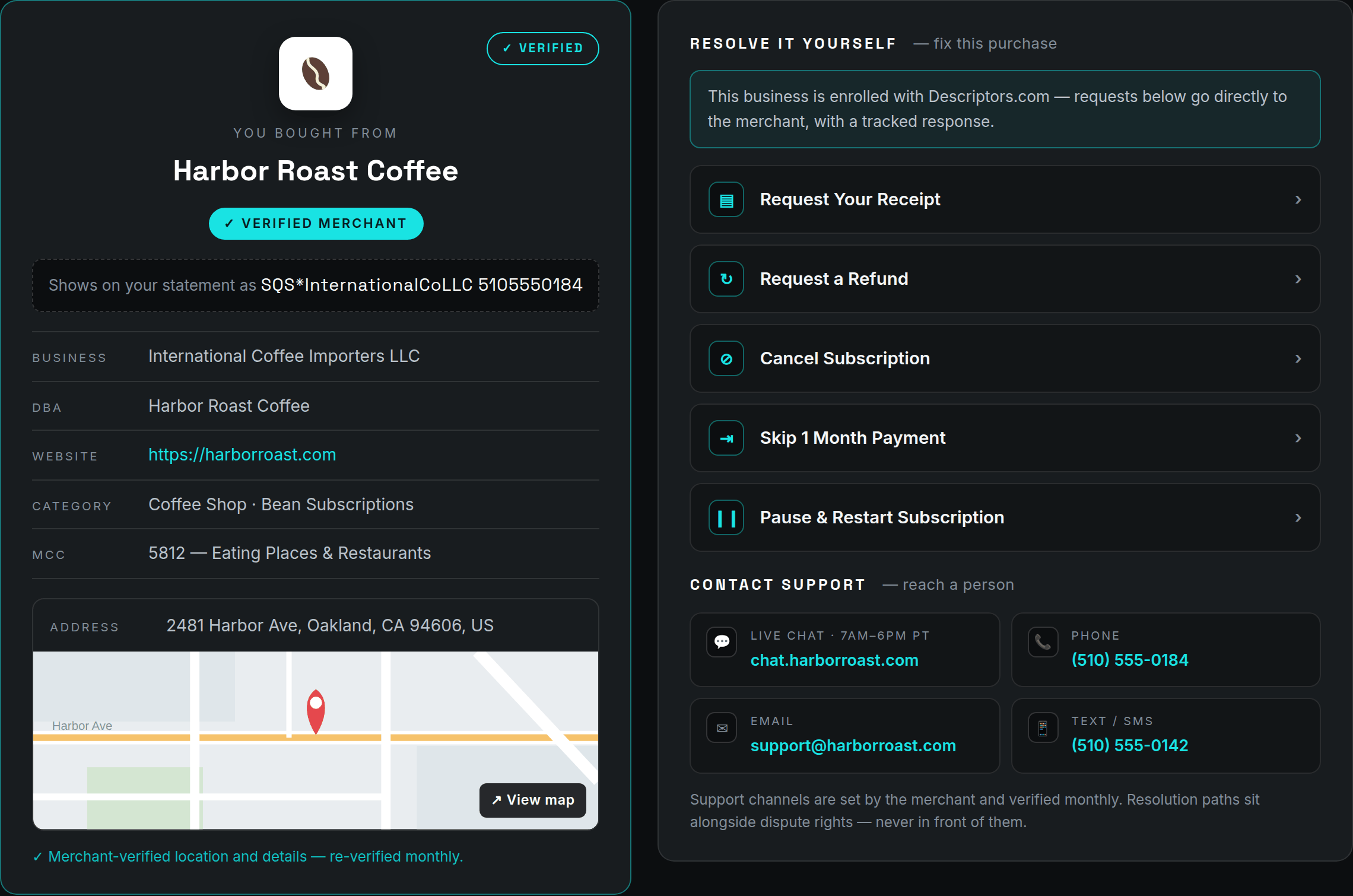
With Descriptors.com, the same charge resolves to a full verified merchant profile:
Customer confusion isn't an unsolved technology problem — it's an unsolved participation problem. The tools built to address it were designed for the largest, most technically sophisticated merchants, and the long tail has never been able to reach them.
“61% of disputes are due to vague merchant descriptions or lack of information, not actual fraud.”
Available for 24 years, and effective where it is deployed. But it asks for an integration, a checkout step, and a per-transaction cost — a reasonable trade for a large merchant, and a hard one for everybody else.
Programs that push order and merchant detail to issuers work well for merchants with engineering teams. They require an API build, which is where most small and mid-sized businesses stop.
Issuers report that 95% of the time, a dispute can be prevented with static merchant identity alone — no receipt-level or order-level data required. Integration-based tools serve the largest merchants well. The other 97% need a path with no integration at all. That is the gap Descriptors.com fills.
Descriptors.com is a neutral data layer built to solve customer confusion at the source — connecting issuers, acquirers & ISOs, merchants, and cardholders around one verified record of who is behind every charge. Descriptors are sourced from the acquirers and ISOs who know their portfolios best, enriched by merchants who know their own businesses best, and made available so the whole ecosystem can resolve confusion at the source.
Every descriptor maps to a real, verified business a cardholder can recognize in seconds — sourced from the acquirers who boarded the merchant. Never scraped. Never AI-guessed.

Nothing is asked of the merchant before their profile exists. The listing is live on day one — built from data the acquirer already holds.
Acquirers and ISOs board portfolios in bulk from records they already hold — descriptor, legal name, DBA, MCC, address, and website. The profile is live before the merchant ever logs in. No merchant API. No merchant integration.
The merchant signs in and completes the profile in about 20 minutes: logo, support phone, live chat, email, and self-service actions — request a receipt, request a refund, cancel an order or subscription.
Customers, banks, and issuers identify the charge on sight — and reach the merchant directly through the profile, resolving it before a dispute is ever filed.
A solution only large, technically sophisticated merchants can access is not a solution to an industry-wide problem. Descriptors.com was built against five requirements — and meets all five.
No merchant API, no code, no developer time. Merchants are enrolled with data the acquirer already holds — participation doesn't wait on an engineering roadmap.
Sign and complete a profile in about 20 minutes, not a project plan. Portfolios board in bulk; merchants enrich on their own time.
Cards, ACH, and alternative payments. Any processor, anywhere in the world. No gateway lock-in and no network dependency.
Designed so the majority of the retail price stays with the acquirer, ISO, or reseller who brings the portfolio — a real revenue line, not a courtesy margin.
$20/month per descriptor — less than the cost of a single chargeback, and low enough that an entire portfolio can be included rather than just the top tier. A solution to customer confusion only works if it reaches the merchants causing the confusion.
Visa and Mastercard are driving disputes down at both the acquirer and the merchant level, and moving enriched merchant data from nice-to-have toward requirement. Confusion-driven disputes are the most preventable share of any portfolio's ratio — and the fastest way to stay ahead of the thresholds.
Merchant: excessive at a VAMP ratio of 1.5% or above (fraud + disputes), effective April 1, 2026.
Acquirer portfolio: 0.5% above standard · 0.7% excessive.
Sustained noncompliance: merchant boarding privileges can be restricted or terminated.
Merchant: excessive chargeback thresholds phase down from 1.5% to 0.9% by 2031.
Acquirer portfolio: 0.5% high dispute · 0.7% excessive.
Assessments: merchant fines scale from $5K to $300K per month.
European issuers must now be supplied enriched merchant data behind every transaction — clean DBA name, logo, contact, and location.
Enhanced merchant data display requirements take effect for issuers in Europe, moving cleaned-up merchant identity from nice-to-have to rule.
These requirements are expected to migrate to the US market. Acquirers who wait will be retrofitting under a deadline. Acquirers who move now set the standard.
The networks have defined roughly four data elements as the requirement, which is the right place to start — it establishes that merchant identity matters. A Descriptors.com profile carries 15–20, because recognizing a charge is only half the job and resolving it directly takes more.

When a charge isn't recognized, the first move is a search — not a phone call. WhoBilled.me, the consumer lookup site powered by Descriptors.com, is live today with tens of thousands of descriptor pages answering “what is this charge?” — routing confused cardholders to the merchant behind the charge instead of the dispute button.
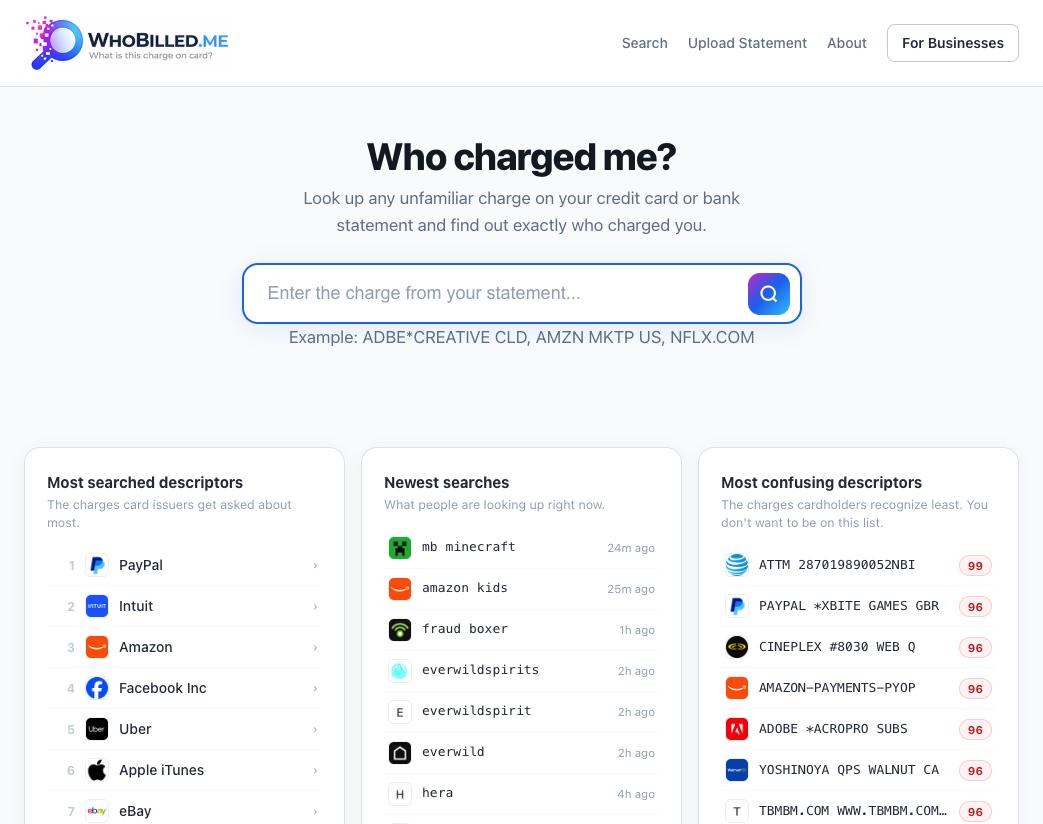
● Live today · whobilled.me
Our Q3 2026 report on 192,911 real billing descriptors. Nearly a third can't be traced to the business behind them, and almost half exceed the networks' own character standard — with the ten worst offenders named. Free, and built to forward.

Make every charge instantly recognizable — quickly, easily, and inexpensively — and stop disputes before they start.
Merchant solutions →Board an entire portfolio from data you already hold, reduce dispute-driven risk, and lower attrition — with the majority of the retail price retained as a new revenue line.
Acquirer & ISO solutions →Give service teams and cardholders a trusted source to identify a charge at the point of statement review — before it becomes a dispute.
Issuer solutions →Boarding a portfolio turns descriptor data into an operational signal. Partners get continuous visibility into descriptor health across every merchant they've boarded, and a descriptor check that can sit directly in the boarding flow as a standard step.
Live boarding and enrichment status for every merchant in the portfolio.
Descriptor collisions between merchants identified and surfaced directly to risk.
High-friction descriptors flagged as they emerge — before they turn into dispute volume.
Lookup traffic on every descriptor. See confusion building before it becomes a dispute.
Non-compliant descriptors surfaced to risk before the networks find them.
Pre-flight validation for every new descriptor at boarding, with suggested fixes for malformed descriptors routed to the merchant or to risk.
Descriptors.com's value depends on trust, and trust depends on neutrality. A few principles govern how the platform operates — and will continue to.
We serve the entire payments ecosystem and have no preference for any network, processor, or payment method.
Acquirers own their merchant relationships and the descriptor data that flows from them. It is contributed voluntarily and used only to serve the ecosystem.
The platform is independently governed, with ownership or control by any card network permanently restricted by charter.
Every feature is designed for the broadest possible participation, at the lowest possible friction.
Verify one descriptor or an entire portfolio. Enroll today, live tomorrow — no API, no integration, no processor change.
