
Your customers and their banks are already looking your business up. Right now the answer they find was assembled by someone else — from transaction data, old directories, and guesswork. Descriptors.com hands you the record itself: what your business is called, what it sells, and exactly how you want a customer to reach you when they have a question about a charge.
Dispute-cause figure from Chargeback Gurus — Srii Srinivasan, co-founder and former CEO, interviewed July 2025.
Every day, customers who don't recognize a charge search for it, and bank support agents look it up on their behalf. They get an answer either way. The only question is whether that answer came from you.
Your trading name as customers know it, your logo, and a plain description of what you actually sell. Not a legal entity from a boarding form, and not a category some third party inferred from your transaction pattern.
You name the support pathways you actually staff — the line you want called, the inbox you monitor, the chat window, the help center article, your cancellation and refund pages. A customer with a question lands where you want them to land, not on a number scraped from a directory that rings nowhere.
Support numbers change. Brands get renamed. New descriptors appear when you add a product line or switch processors. The profile is yours to maintain, and it is timestamped and reconfirmed so anyone reading it knows how fresh it is.
Ownership is verified before anything appears under your name, and only you can change it afterward. Your acquirer or ISO can help you get set up, but the record belongs to your business.
Merchant identity is already being published about you, by services that infer it from data you never reviewed. Owning your profile is how you replace a guess with a fact — and it is the same reason you claim your business listing on a map or a review site rather than leaving whatever is there.
When a customer doesn't recognize a legitimate charge and files anyway, you are not defending against fraud. You are absorbing the cost of a name they couldn't read.
A confusion dispute is the least winnable kind. There is no fraud to disprove, because there was no fraud. The customer genuinely bought the thing — they just didn't recognize the name attached to it.
Representment can't fix a recognition problem after the fact. The only place to solve it is before the statement is read.
Your descriptor was probably set once, when you were boarded, inside a field that was never designed to carry a brand. Four things go wrong from there — and most merchants have at least two of them.
Boarding captures your legal entity. Customers know your storefront, your app, or your product line. If the two don't match, the charge reads as a stranger's — and the customer is doing nothing unreasonable when they flag it.
Twenty-two characters have to carry your name, and often a prefix and a location too. Truncation and abbreviation are not sloppiness; they are what fits. What survives is frequently unreadable.
Free trials that convert, annual renewals, subscriptions billed a month after signup, deliveries charged at fulfillment. The further the charge drifts from the moment of buying, the less memory there is to match it against.
If you sell through a payment facilitator or a merchant of record, their prefix leads the descriptor. Your customer has a relationship with you and has never heard of them — so the charge looks like it came from somewhere else entirely.
You can't make the statement field bigger. You can own the record everyone reads when they look up what's in it — the customer, their bank's support agent, and the bank's own systems.
Search the string exactly as it appears on your customers' statements and claim it. If it isn't in the registry yet, register it. Ownership is verified before anything is published under your name.
Logo, trading name, what you sell, where you operate, and the support paths you actually staff — phone, email, chat, help center, plus your refund and cancellation pages. You choose every field, including which door you want a confused customer to come through.
Descriptors change when you add a product line, switch processors, or open a new entity. Support numbers and policies change too. Your profile is timestamped and reconfirmed monthly, so the record moves when the business does.
Other services try to infer merchant identity from transaction data. We don't. Descriptors.com is built from data supplied directly by acquirers, ISOs, and merchants themselves, then confirmed with the business it belongs to. Your profile says what you say it says — not what an algorithm concluded about you.
A customer who doesn't recognize a charge searches for it first. Today most of those searches end nowhere, so the next stop is the bank. Descriptors.com puts an answer where the search happens.

WhoBilled.me is the free consumer lookup site powered by Descriptors.com, live today with tens of thousands of descriptor pages. A customer pastes the string from their statement and gets the business behind it — your logo, your description, and the support channels you nominated, rather than a dead end.
The same record reaches issuer support agents and, through our API, the banking apps where cardholders review their transactions. One profile, maintained by you, answering the question everywhere it gets asked.
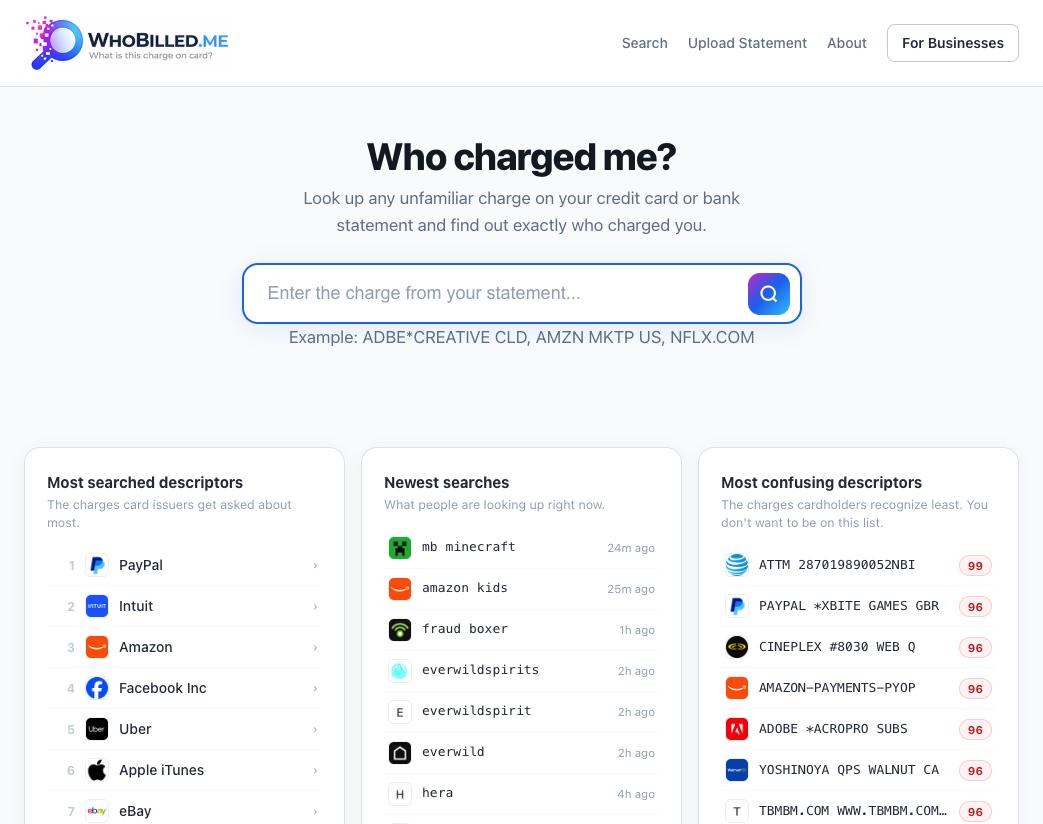
● Live today · whobilled.me
Plenty of payments projects stall waiting on a processor, an integration, or a quarter of engineering time. Claiming your own profile doesn't.
If your acquirer or ISO already resells Descriptors.com, they can board you. If they don't, you can claim your descriptor yourself today at $20 per month. Nothing about your processing arrangement has to change.
There is no SDK, no endpoint to call, and nothing to deploy. Your profile is a record in a registry that other systems read. Set it up in a browser in a few minutes.
Most businesses run more than one string — separate brands, regions, entities, or billing systems. Claim each one, so no part of your customer base is left with a record you don't control.
Roughly 55% of all disputes come from a cardholder not recognizing a charge. Put your own numbers in and see what removing even a small slice of that is worth — against the alert fees, chargeback fees and lost order value you are paying today.
—
Every payment type, every market. Nothing to build.
Fees you stop paying counts only money you do not get invoiced for — the alert fee on disputes your alert program would have caught, and the acquirer chargeback fee on the rest. It excludes order value, so it is the conservative figure. Including revenue kept adds back the order value you no longer refund.
Percentages are a reduction in total dispute volume, not a share of the addressable pool. The confusion-share assumption above sets that pool and you can change it.
This model defaults to a deliberately conservative 55% confusion share. Elsewhere on this site we cite 61%, from a named industry source. The point of the default is that the arithmetic holds at the lower figure, and the assumption is yours to move.
Not included, and all of which push the number up: card-network monitoring fines, remediation costs, staff time spent working an alert queue, and the acquirer-relationship cost of sitting near a VAMP, ECM/HECM or EFM threshold. Fraud-record counts assume deflected disputes were fraud-coded at the rate set above; issuers classify a considerably higher share of disputes as fraud than merchants typically expect.
This is an arithmetic model of your own inputs, not a performance guarantee or a forecast. Actual results depend on your descriptor quality, customer base, vertical and payment mix.
Reconcile every acquirer and processor statement automatically, see your true cost of payments in one place, and catch anomalies, duplicate charges, and excessive fees before they compound across a year.
Learn more →Strategy for processor selection, contract negotiation, authorization optimization, and cross-border expansion — specific best-of-breed recommendations from senior payments operators, carried through deployment, with no fee for qualifying merchants.
Learn more →Six questions, about three minutes: authorization rate, fraud, chargebacks, refunds, disputes, and what you actually pay to process. Benchmarked against your business model — not a generic average — with an instant read on where you're strong and where you're leaking money.
2.9% effective rate · $62 avg ticket
At a $62 average ticket, the interchange floor for this MCC is 2.11%. The reported 2.9% is a gap of about 79 bps — roughly $7,887 a year on $1M of volume.
Directional estimate — the tool marks what's authoritative versus indicative, and never invents an “industry average.”
Look up the descriptor your customers actually see. If it's already in the registry, claim it and fill in who you are and how you want to be reached. If it isn't there yet, register it. Either way it takes minutes, and it costs less than one chargeback a month.
